This study explores how a tundra plant community at Zackenberg in NE Greenland is influenced by both grazing animals and climate warming. The Arctic is a nutrient‑poor environment, so plants are strongly affected by changes in temperature and by herbivores such as muskoxen, which feed heavily on vegetation. As the Arctic warms, plant growth is increasing, but at the same time the numbers and movements of large grazing animals are changing. Understanding how these two forces interact is important for predicting future ecosystem changes.
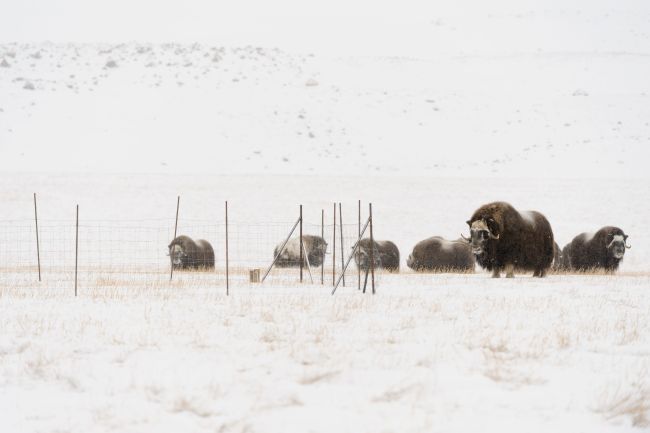
To investigate this, we conducted a 13‑year experiment in a wet Arctic fen, where we fenced off small areas to exclude muskoxen while leaving nearby areas open to grazing and trampling. Initially, the effects of excluding muskoxen were clear. After only five years, fenced areas held much more plant biomass and nitrogen, indicating that muskox grazing and trampling limit vegetation growth.
Over the longer term, however, these differences faded. Muskox numbers in the region declined during the study, reducing grazing pressure even in unfenced areas. Hence, 13 years after the establishment of the experiment, plant biomass and nitrogen pools had increased both inside and outside the fenced areas, and the treatment effect was no longer evident.
The declining muskox population at Zackenberg reduces its influence on the tundra vegetation, allowing climate warming to drive widespread increases in plant growth. These changes are likely to affect how nutrients and energy move through Arctic ecosystems, with possible knock-on effects in freshwater and coastal ecosystems.
Reference: Brockmann, F. K., Michelsen, A., Stewart, L., van Beest, F. M., Hansson, S. V., & Schmidt, N. M. (2026). Herbivore decline switches a high Arctic plant community from top-down to bottom-up control. Journal of Ecology, 114, e70308. https://doi.org/10.1111/1365-2745.70308
Text: Niels Martin Schmidt, Aarhus University / Picture: Muskox exclosures at Zackenberg, Lars Holst Hansen.