The Norwegian Institute for Nature Research (NINA) is looking to strengthen the terrestrial ecology group in Tromsø and is therefore seeking a skilled and dedicated researcher to fill a permanent position.
Core responsibilities include acquisition of new projects, project development, proposal writing, as well as implementation and reporting of research projects. Publishing scientific papers, and development of research projects at national and international levels are also important tasks. Participation in fieldwork is expected.
Find out more about this exciting opportunity here.
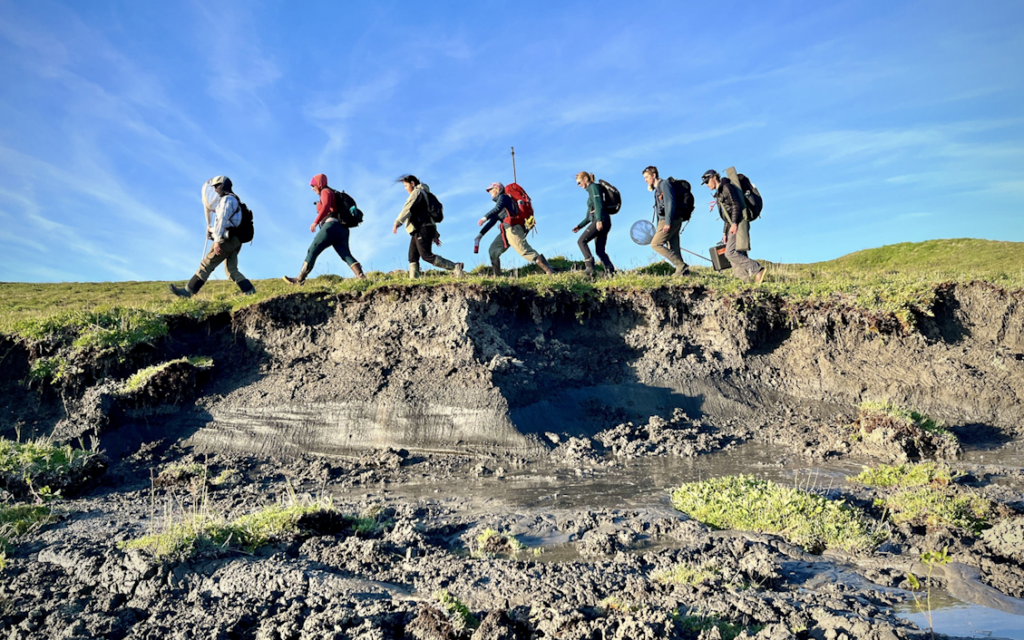
Team Shrub walking across a new thaw slump. Photo: Elias Bowman.
One postdoc will lead ITEX phenology syntheses including the integration of phenocam and below-ground data as a part of the Canada Excellence Research Chair Project on the global change ecology of northern ecosystems. The other postdoc will join the European Research Council Resilience project to look at spatial patterning in tundra ecosystems and how they might influence resilience in the face of global change.
There will be opportunities for fieldwork in the Canadian Arctic and potentially elsewhere as a part of both of these positions. The two postdocs will join the teams for these two projects based at the University of British Columbia and will have the opportunity to work with collaborators in North America and Europe and across the ITEX network. These postdocs will join current UBC postdoc Jeremy Borderieux who is leading new data syntheses with the ITEX plant composition data focusing on community assembly and spatial patterning as a part of the Resilience Project and the recruited Tundra Time postdoc at the University of Edinburgh (see below).
You can check out the positions and apply at the following links:
We are looking for a highly motivated and skilled PhD researcher to join the Department of Geographical and Historical Studies at the University of Eastern Finland, under the supervision of Assistant Professor Miguel Villoslada.
Amid the ongoing shifts in Arctic ecosystems driven by climate change, Finland has recently experienced significant outbreaks of the Common heath moth (Ematurga atomaria), severely impacting crowberry-dominated heath tundra ecosystems in Lapland. These events raise critical ecosystem management questions: When and where did the outbreaks start? How quickly are they spreading? What are the precise extents of affected areas? And most importantly, have the outbreaks caused substantial changes in ecosystem functions and services? Simultaneously, recent research indicates an increase in the dominance and biomass of crowberry (Empetrum nigrum) in various locations across the Arctic. This evergreening process may have deep implications in essential ecosystem functions. The overarching aim of the PhD project is addressing the complex interplay between browning and greening processes in heath tundra ecosystems, through the lens of multi-platform remote sensing.
The PhD project will integrate advanced remote sensing techniques, drone imagery, and in-situ data collection to deliver insights about the dynamics the defoliation outbreak. The successful PhD applicant will combine state-of-the art in-situ data (chlorophyll content, soil moisture and temperature, vegetation composition, GHG data, and field hyperspectral imagery) with multispectral drone imagery and various satellite products. Among the analysis tools used in the project, the applicant will apply machine and deep learning, time series and change detection analysis, and species distribution models, among others.
The PhD researcher will be based at the Joensuu campus of the University of Eastern Finland, at the Department of Geographical and Historical Studies, and will be supervised by Miguel Villoslada, working closely with other members of Digital Geosciences research group. The deadline for applications is November 10, 2024. The position will be filled starting from 1 January 2025, or as agreed, for a fixed term of three years. The position is full-time. A probationary period is applied to new members of the staff.
The salary of the position is based on the salary system for the teaching and research staff of Finnish universities. The salary consists of a job-related salary element and a personal salary element. In this position, the job-related salary element is based on level 2–4 of the job requirement level chart (EUR 2,225.83 – 2,775.28), and the personal salary element is 6–50% of the job-related salary element. In the position of a Doctoral Researcher, the salary is determined based on the stage of doctoral research and doctoral studies, as well as on personal performance.
More information on the application process and the application submission can be found following this link.
Please do not hesitate to contact Miguel Villoslada (miguel.villoslada@uef.fi) if you have any questions.